 |
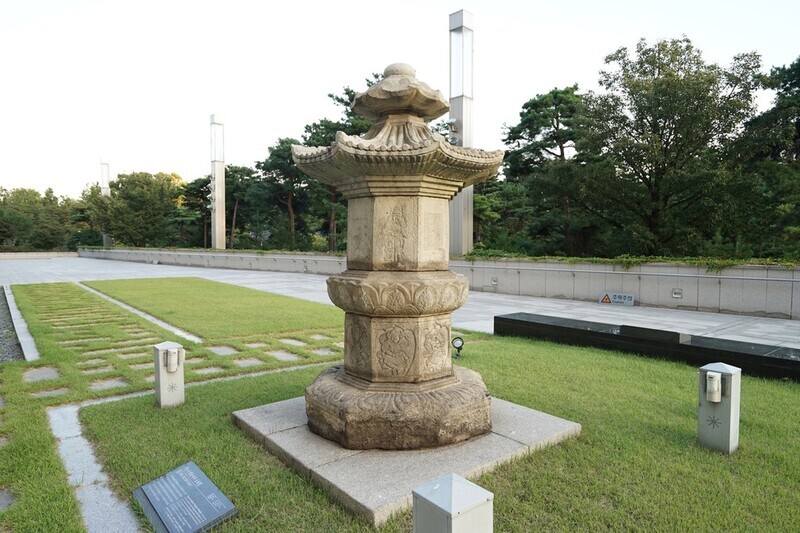
| ▲ This photo provided by the Korea Heritage Service shows Wongong Guksa's Stupa at Geodonsa Temple Site in Wonju, Gangwon Province. (PHOTO NOT FOR SALE)(Yonhap) |
SEOUL, Aug. 19 (Yonhap) -- The stupa containing the remains of Wongong Guksa Jichong, a Goryeo Dynasty monk who lived from 930 to 1018, is expected to return to its "hometown" in Wonju, Gangwon Province, after spending more than a century away from its original site since the Japanese colonial period.
According to the Korea Heritage Service on Wednesday, the National Heritage Committee approved last month a detailed plan to relocate Treasure-designated Wongong Guksa's Stupa at Geodonsa Temple Site in Wonju and a project to prepare the area where it is to be relocated.
The plan covers the relocation of the stupa, currently in Seoul, to Wonju.
A Korea Heritage Service official said the relocation is being pursued with the aim of returning the stupa to Wonju, where it originally stood, but added that "a specific schedule or timing has not yet been finalized."
Geodonsa Temple in Wonju is believed to have been first built around the ninth century, during the late Silla period, and greatly expanded during the Goryeo Dynasty before continuing into the early Joseon period.
The stupa remaining at the former temple site is believed to have been erected at Geodonsa around 1025, together with the stele documenting Wongong Guksa's life, now designated as Treasure Wongong Guksa's Stele at Geodonsa Temple Site in Wonju.
 |
| ▲ This photo provided by the National Museum of Korea shows the glass-plate negative from the former appearance of Treasure-designated Wongong Guksa's Stupa at Geodonsa Temple Site in Wonju, Gangwon Province. (PHOTO NOT FOR SALE)(Yonhap) |
The Korea Heritage Service's National Heritage Portal describes it as "a representative octagonal reliquary stupa from the early Goryeo period," noting that it has well-proportioned forms and "a dignified, substantial character."
The millennium-old stupa is also known for its long history of being moved from place to place.
According to the National Heritage Portal, the stupa was kept at the home of a Japanese national during the Japanese colonial period before being moved to Gyeongbok Palace in 1948. It was designated a Treasure in 1963.
After becoming part of the collection of the National Museum, the predecessor of the National Museum of Korea, it was moved again in 2005 when the National Museum of Korea relocated to Yongsan.
It currently stands in an outdoor area on the museum grounds.
Stupas containing the remains of eminent monks and their accompanying steles normally form a pair, but in the case of Wongong Guksa's Stupa, nearly a century has passed since it was separated from its stele, which remains in Wonju.
A replica made by Lee Jae-sun, holder of the National Intangible Cultural Heritage designation for stone craftsmanship, has been installed at the original site of the stupa.
Against this backdrop, local communities in Wonju have consistently called for major cultural heritage items that originated in the city, including Wongong Guksa's Stupa, to be returned to their original locations.
The latest result of years of discussions was National Treasure Jigwang Guksa's Stupa at Beopcheonsa Temple Site in Wonju.
The stupa, which originally stood at the former Beopcheonsa Temple site, was first taken away in 1911 during the Japanese colonial period. After being moved through Myeongdong in Seoul, Osaka in Japan and Gyeongbok Palace, it finally returned to its hometown in 2024.
The return came after conservation treatment of the stupa's components and restoration work, marking its "homecoming" after 113 years.
The Korea Heritage Service, Wonju City and the National Museum of Korea are reportedly preparing detailed plans while positively reviewing the return of Wongong Guksa's Stupa to its original location following the return of Jigwang Guksa's Stupa.
The process of bringing the stupa back to its hometown is expected to take some time.
If the relocation is finalized, all components of Wongong Guksa's Stupa, which weigh more than 10 tons in total, will have to be dismantled, transported to Wonju and reassembled. The replica currently standing at the original site will also have to be dismantled, with a storage location to be determined.
Specific plans are expected to be finalized through further consultations.
[Copyright ⓒ K-VIBE. All rights reserved. Unauthorized reproduction and redistribution are prohibited.]