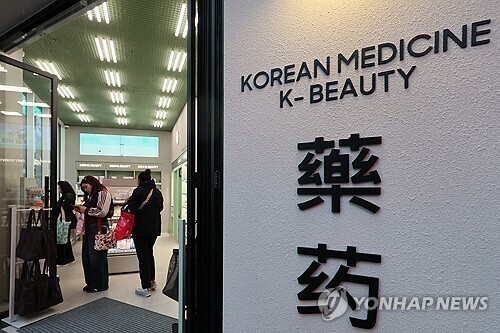
SEOUL, Nov. 10 (Yonhap) -- "Korean cosmetics are popular in Japan, too, so I came to a pharmacy. I was curious because I heard there are products sold exclusively at pharmacies."
Yamamoto, a Japanese woman in her 30s whom a reporter met at a pharmacy in Myeongdong, central Seoul, on Nov. 4, said she had wanted to visit a pharmacy even before traveling to South Korea.
After purchasing acne medication and an ointment for her lips, she asked a staff member to recommend products she could buy as gifts for friends back in Japan.
Amid the K-beauty boom, so-called "beauty pharmacies" are rapidly spreading across central Seoul. However, concerns have also been raised that pharmacies should not prioritize cosmetics over medicines.
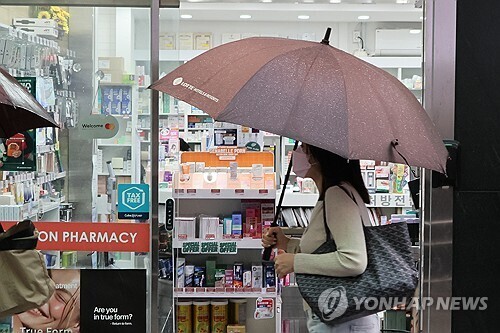
◇ Pharmacies in central Seoul's Jung district surge 21% in a year; chain-style beauty pharmacies emerge
Beauty pharmacies targeting foreign tourists are characterized by prominently displaying cosmetics and medicines related to skincare and beauty treatments.
From the outside, beauty pharmacies look little different from cosmetics stores, and most have more sales staff than pharmacists on their premises. Many also advertise tax-free shopping.
Ready Young Pharmacy, which operates outlets in Myeongdong, Dongdaemun and Seongsu-dong, explicitly promotes itself as a "drugstore" focused on "health and beauty." Its Japanese-language Instagram account features content on sheet masks, wrinkle and pore patches, and derma cosmetics, or functional skincare products.
The growing number of beauty pharmacies is also reflected in the Seoul Metropolitan Government's pharmacy licensing data.
The number of pharmacies in Jung district rose 20.9 percent to 214 in October this year from 177 a year earlier, the highest growth rate among Seoul's 25 districts over the period.
The number of pharmacies also increased 10.4 percent in Mapo district, home to the Hongdae area, and 9.4 percent in Seongdong district, where Seongsu-dong is located. Hongdae and Seongsu-dong, along with Myeongdong, are among the areas seeing a rise in beauty pharmacies.
According to medical tourism data from the Korea Tourism Data Lab, foreign tourists' medical spending in South Korea totaled 1.8398 trillion won (US$1.3 billion) in the January-September period this year, up 57.9 percent from the same period last year.
Spending at pharmacies during the period is estimated to have surged approximately 196.1 percent from a year earlier.
A pharmacist who has operated a beauty pharmacy in Myeongdong since February said, "Almost all our customers are foreigners, and many come looking for cosmetics and skincare products. Products for treating dark spots are particularly popular."
"Since we opened, I think the number of pharmacies in the neighborhood has tripled," the pharmacist said. "Competition has intensified to the point that sometimes only one or two groups of customers come in an hour."
"Tourists from Asian countries are particularly sensitive to prices," the pharmacist added. "It's unfortunate that we have no choice but to compete on prices with nearby pharmacies."
◇ Expansion of cosmetics businesses by Korean biotech firms also contributes; opinions divided
The emergence of beauty pharmacies has coincided with South Korean pharmaceutical and biotech companies' entry into the cosmetics market. Pharmaceutical firms have recently been applying technologies accumulated through drug development to cosmetics manufacturing.
Dongkook Pharmaceutical Co. (086450), the maker of the wound treatment ointment Madecassol, launched its derma-cosmetics brand Centellian24 in 2015, using a key ingredient in Madecassol. The brand has received a favorable response.
The company is pursuing a plan to change its corporate name to DK Centellian as part of efforts to expand more aggressively into the beauty sector.
An industry official associated with beauty pharmacies said skincare products sold at pharmacies differ in ingredients from ordinary cosmetics, emphasizing that pharmacy products have their own distinctive characteristics.
"South Korean pharmaceutical companies are generally good at making medicines," an official from the Korean Pharmaceutical Association said. "Approval standards for medicines vary from country to country, and some products with good efficacy can be purchased without a prescription in South Korea."
As pharmacies in the country grow larger and become more specialized, opinions are divided over the mushrooming number of beauty pharmacies.
Some view them as a new channel for promoting the appeal of K-beauty, while others warn that placing too much emphasis on cosmetics could undermine pharmacies' fundamental purpose.
"It is positive that pharmacies are developing specialized services," the pharmaceutical association official said. "Pharmacists can provide detailed consultations on functional products, including those for skin whitening and acne relief."
"However, focusing on cosmetics sales could cause pharmacies to neglect their fundamental role of dispensing medicines," the official said. "Pharmacies with heavy foot traffic should ensure that customers have sufficient space and opportunities to consult pharmacists and receive proper guidance on medication use."
jwc@yna.co.kr
[Copyright ⓒ K-VIBE. All rights reserved. Unauthorized reproduction and redistribution are prohibited.]