 |
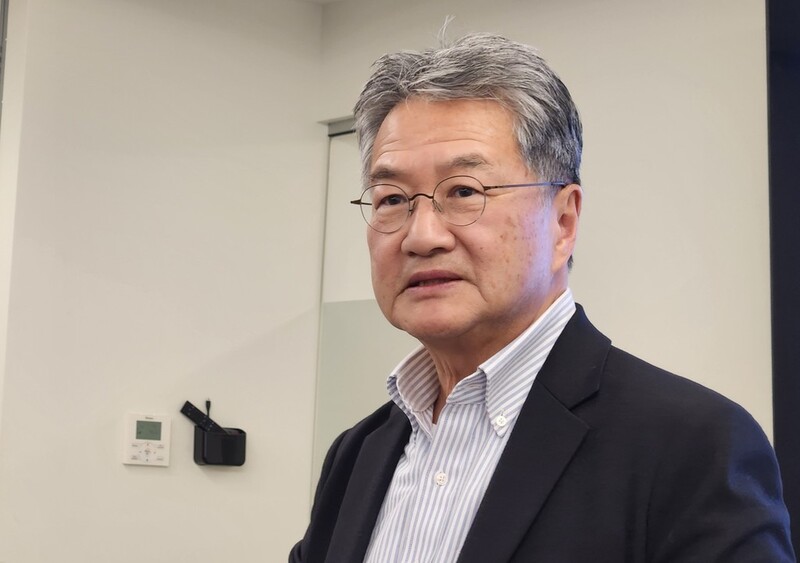
| ▲ Former U.S. Special Representative for North Korea Joseph Yun speaks during a seminar hosted by the Korea Inter-parliamentary Exchange Center in Washington on Jan. 16, 2026. (Yonhap) |
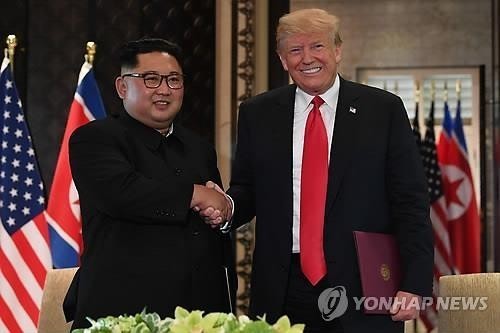 |
| ▲ This AFP photo shows U.S. President Donald Trump (R) shaking hands with North Korean leader Kim Jong-un after signing a joint statement at the Capella Hotel on Sentosa Island in Singapore on June 12, 2018. (Yonhap) |
ex-US envoy-N Korea
N. Korea would want nuclear arms acknowledgment, sanctions removal if it accedes to dialogue with U.S.: ex-U.S. envoy
By Song Sang-ho
WASHINGTON, Jan. 16 (Yonhap) -- A former U.S. nuclear envoy said Friday that North Korea would aim to have its nuclear weapons "acknowledged and accepted," like Pakistan's, and secure the lifting of sanctions should it accede to U.S. overtures for dialogue.
Former U.S. Special Representative for North Korea Joseph Yun, who served as acting ambassador to Seoul from January last year to October, made the remarks during a seminar, noting that despite U.S. President Donald Trump's wishes to resume dialogue with North Korean leader Kim Jong-un, Kim does not appear to be ready.
His remarks came amid growing speculation that Trump could seek reengagement with Kim in the coming months as he plans to visit China in April for talks with Chinese President Xi Jinping.
"North Korean goals are twofold. One is to lift sanctions and second is to have their nuclear weapons acknowledged and accepted," Yun said during the seminar on the South Korea-U.S. alliance hosted by the Korea Inter-parliamentary Exchange Center.
"I mean it's just a little bit different from a recognized nuclear weapons power, but I think at minimum, they want to be at a similar level as, say, Pakistan ... If they were guaranteed to get (the two conditions), I would imagine they would come to talks."
He was referring to North Korea's hope to get de-facto nuclear state status outside the Nuclear Non-Proliferation Treaty (NPT) framework -- different from the five officially recognized nuclear weapon states under the NPT system: the United States, Britain, France, China and Russia.
Yun noted that although there is "no doubt" about the Trump administration's desire to engage North Korea, Kim does not seem to be prepared for dialogue.
"You know, it takes two to tango," he said.
The former envoy listed a range of reasons for North Korea's lack of interest in diplomacy with the U.S.
They included Pyongyang's "closeness" with Moscow following its dispatch of troops to Russia, and its traditional ties with China, which were underscored by the joint appearance of Chinese President Xi Jinping, Kim and Russian President Vladimir Putin during a military parade in Beijing in September.
Yun also pointed out that North Korea has been making money by sending troops to help Russia's war against Ukraine as well as through cyber thefts and other means -- a reason why the North Korean leader's appetite for diplomacy with the U.S. might have dwindled.
Kim's empty-handed return home after the no-deal summit with Trump in Hanoi in February 2019 might also be weighing on his mind, he said.
Yun underscored Seoul's role in facilitating dialogue between the U.S. and North Korea, calling it "pivotal."
"Without South Korean help, there can be no talks," he said, pointing to Seoul's efforts to support diplomacy between Trump and Kim during the first Trump administration.
"Without South Korean help, the U.S. cannot accomplish anything."
Touching on U.S. approval of South Korea's push to secure nuclear-powered submarines, Yun anticipated that it will materialize despite "some skepticism."
"I think that's going to happen. There is some skepticism, but I think it is misplaced," he said.
"There is certainly a will in the Trump administration to accommodate nuclear submarines, and this is something that the South Korean government very much wants."
He also expressed optimism about Seoul's drive to secure civil uranium enrichment and spent nuclear fuel reprocessing rights, as he highlighted that the issue was addressed in an agreement between South Korean President Lee Jae Myung and Trump during their summit in late October.
Asked about when Trump will nominate his full-fledged ambassador to South Korea, Yun said that he thinks the Trump team is looking for an envoy that is "very close to President Trump" and "very senior."
"There are a number of countries that the Trump administration hasn't found one. Germany is another," he said. So I know that Korea and Germany are on the very top of the list, and they are still looking."
Currently, James Heller, deputy chief of mission at the U.S. Embassy in Seoul, serves as charge d'affaires ad interim, as Kevin Kim, former acting ambassador, recently returned to Washington. The ambassador seat has been vacant since former Ambassador Philip Goldberg left the post in January last year.
Yun looked back on his time as the acting ambassador in Seoul when uncertainty grew over the future of the bilateral alliance at a time of political turmoil in Seoul, caused by former President Yoon Suk Yeol's martial law bid in late 2024, with the launch of the second Trump administration raising questions over its policy toward the Asian ally.
"I think the alliance remains as strong as it's been," he said.
(END)
(C) Yonhap News Agency. All Rights Reserved