(News Focus) Trump-S Korea-alliance
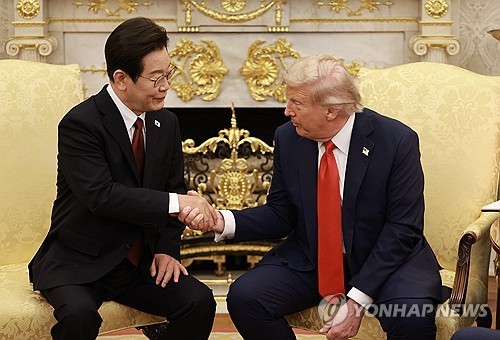 |
| ▲ This photo, taken on Aug. 25, 2025, shows South Korean President Lee Jae Myung (L) shaking hands with U.S. President Donald Trump during their talks in the Oval Office of the White House in Washington. (Yonhap) |
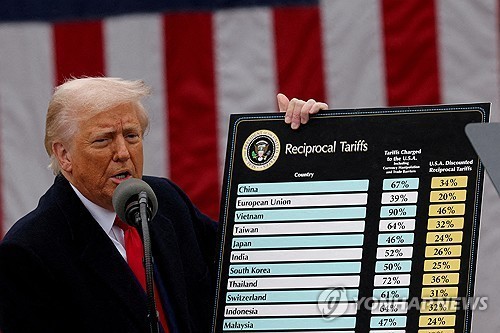 |
| ▲ This file photo, released by Reuters, shows U.S. President Donald Trump delivering remarks on tariffs in the Rose Garden at the White House in Washington on April 2, 2025. (Yonhap) |
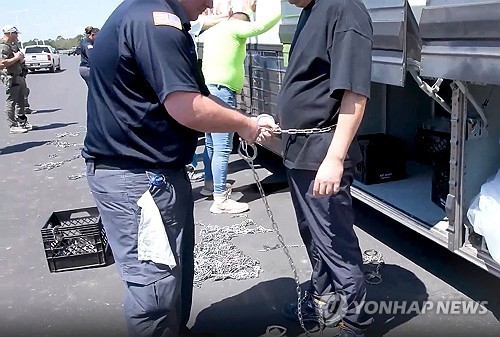 |
| ▲ This photo captured from video footage posted on the Immigration and Customs Enforcement website shows a U.S. official shackling a worker with a metal chain during an immigration raid at an electric vehicle battery plant construction site for a Hyundai Motor Group-LG Energy Solution joint venture in Bryan County near Savannah on Sept. 4, 2025. (PHOTO NOT FOR SALE) (Yonhap) |
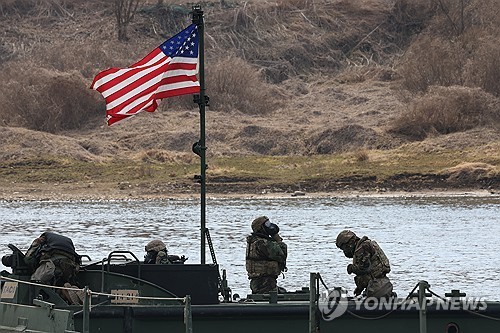 |
| ▲ This file photo, taken March 20, 2024, shows U.S. troops engaging in a river-crossing exercise in Yeoncheon, about 60 kilometers north of Seoul. (Yonhap) |
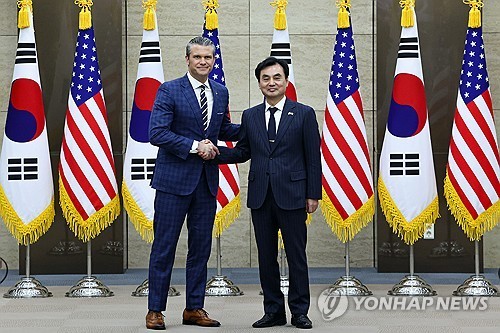 |
| ▲ This file photo, taken on Nov. 4, 2025, shows South Korean Defense Minister Ahn Gyu-back (R) shaking hands with U.S. Defense Secretary Pete Hegseth before the two countries' annual Security Consultative Meeting in Seoul. (Pool photo) (Yonhap) |
(News Focus) Trump-S Korea-alliance
(News Focus) S. Korea-U.S. alliance navigates year of uncertainty following Trump's return to power
By Song Sang-ho
WASHINGTON, Jan. 13 (Yonhap) -- From trade to security and geopolitics, the South Korea-U.S. alliance has undergone a year of uncertainty since U.S. President Donald Trump's return to the White House, but hard-fought bilateral deals in those areas have put it on a more stable footing.
Trump kicked off his second, nonconsecutive term on Jan. 20 at a time of growing questions over the future course of the alliance as he moved to put his America First policy into high gear while Seoul was struggling with the aftermath of former President Yoon Suk Yeol's failed martial law bid.
His aggressive tariff policy and calls for allies to bolster their defense spending and "burden-sharing" heralded profound shifts in America's alliances and partnerships, leaving Seoul scrambling to figure out ways to navigate those changes in the absence of a fully elected leader following Yoon's impeachment in December 2024 and his ouster in April.
New South Korean President Lee Jae Myung was elected in June on a promise to put the alliance with the United States at the center of his administration's foreign policy under his "pragmatic" diplomacy, easing speculation in Washington that under his leadership, Seoul could lean more toward America's strategic rival, China.
Mindful of concerns over delayed summit diplomacy with Trump due to the political transition in Seoul, Lee sought to swiftly engage with Trump, leading to the first bilateral summit at the White House in August and the second in South Korea in late October just ahead of the Asia-Pacific Economic Cooperation summit.
Released in November following the two summits, a joint fact sheet outlining bilateral security and trade agreements has given a sense of stability to the South Korea-U.S. relationship, but tougher tasks remained: turning those deals -- some lacking specifics -- into reality.
The fact sheet, the first top-level official document between the two administrations, covered a wide range of agreements, including Seoul's commitment to investing US$350 billion in the U.S., among other pledges, in return for Washington's lowering of country-specific "reciprocal" tariffs on South Korea to 15 percent from 25 perce.
Despite months of grueling negotiations to reach a tariff deal, uncertainty still remains over the terms of the agreement as the U.S. Supreme Court could issue a ruling in the coming weeks regarding the legality of Trump's use of emergency powers to justify the reciprocal tariffs.
In the event of a court decision against the duties, Trump is expected to deploy other legal means at his disposal to maintain the same level of tariffs, but the Lee administration could face domestic pressure against its investment commitment made in exchange for the tariff reduction, observers said.
Trump announced his plans for reciprocal tariffs on April 2 -- a day he called "Liberation Day" -- as he used import taxes to curtail America's trade deficits, boost revenue, attract foreign investments and strengthen domestic manufacturing.
Trade and investment matters aside, geopolitical coordination has been a tricky issue facing the two governments.
Shortly after Lee's election, a White House official expressed concerns over "Chinese interference and influence" in democracies around the world -- a remark that apparently suggested the Trump administration's desire to see Seoul keep a distance from Beijing amid an intensifying Sino-U.S. rivalry.
The White House remark came amid speculation in Washington that the liberal-leaning administration in Seoul would seek closer ties with China, whereas the former conservative Yoon government had focused on strengthening bilateral and trilateral ties with Washington and Tokyo.
The Lee administration has sought to ease Washington's geopolitical concerns, underscoring that the South Korea-U.S. alliance lies at the center of its foreign and security policy, while expressing its support for continued trilateral cooperation with Tokyo.
Finding an optimal policy approach toward China that does not strain ties with the U.S. remains a major task for Seoul, as the Trump administration wants its Indo-Pacific allies and partners to coalesce around its efforts to deter the "pacing" threat from an assertive China.
One of the most embarrassing moments for the Seoul-Washington ties last year came in September when Immigration and Customs Enforcement (ICE) officials conducted a raid at a Korean battery plant construction site in Georgia, leading to the detention of more than 300 Korean workers and raising doubts over the U.S. as a reliable investment destination.
ICE officials called the raid the "largest single-site enforcement operation in the history of Homeland Security Investigations," arguing that the Korean employees were found to be working illegally in the U.S., including those on short-term or recreational visas.
The workers were released a week after their detention, but the scene of them being arrested in shackles sparked anger and even a sense of betrayal in South Korea as they were posted there to support Korean businesses' investments in the U.S.
Later, U.S. Deputy Secretary of State Christopher Landau expressed deep regrets over the incident and pledged to fix the U.S. visa system. To address the visa issue, Seoul and Washington established a working group, while the U.S. created a special desk at the U.S. Embassy in Seoul.
On the security front, one of the biggest issues concerns the joint project to "modernize" the alliance.
The Trump administration has sought to reshape the security partnership with South Korea in a way that increases Seoul's defense spending and security responsibilities, and enables U.S. forces to focus on broader regional threats beyond the Korean Peninsula, namely those from China.
In the context of the alliance modernization, speculation has persisted about the possibility of the U.S. broadening the operational scope of its 28,500-strong U.S. Forces Korea (USFK) beyond the Korean Peninsula in the face of China's growing assertiveness.
Observers have also anticipated that to help counter Chinese threats, the U.S. military could strengthen Air Force and Navy components of USFK, and reduce its Army portion, given that naval and aerial assets might play a central role in the event of China-related contingencies.
Concerns about a potential USFK troop drawdown were reinforced as a joint communique of the bilateral defense ministerial talks in November omitted what had been a boilerplate phrase committing the U.S. to maintaining the "current" USFK troop level.
The allies' discussions about the USFK force posture are expected to pick up pace after the Pentagon releases its National Defense Strategy, likely in the coming weeks.
Another major security issue facing the alliance has been Seoul's push to secure nuclear-powered submarines.
Following the second summit with Lee, Trump announced that he approved the submarine project, dismissing earlier skepticism that the U.S. would remain averse to South Korea's pursuit of the strategic naval asset due to nuclear proliferation concerns.
His approval came amid speculation that Washington could rely on South Korea's powerful submarines to deal with Chinese threats. The path to getting the submarines seems to be neither quick nor easy given domestic U.S. procedures and other requirements.
Also on the crowded agenda of the allies' security tasks was Seoul's push to secure uranium enrichment and spent nuclear fuel reprocessing capabilities for peaceful civilian purposes. In the November fact sheet, the U.S. officially expressed its support for that effort.
Last year, the two countries also made progress in their discussions on the transfer of wartime operational control (OPCON) to South Korea from the U.S.
During their annual talks in Seoul in November, Defense Minister Ahn Gyu-back and Defense Secretary Pete Hegseth agreed to develop a road map designed to "expedite" the implementation of conditions for the OPCON transition, as the Lee administration seeks to retake wartime OPCON within its five-year term ending in 2030.
The allies have been working on the "conditions-based" OPCON transition. The conditions include South Korea's capabilities to lead combined Korea-U.S. forces, its strike and air defense capabilities, and a regional security environment conducive to such a handover.
South Korea handed over operational control of its troops to the U.S.-led U.N. Command during the 1950-53 Korean War. It was then transferred to the two allies' Combined Forces Command when the command was launched in 1978. Wartime OPCON remains in U.S. hands, while South Korea retook peacetime OPCON in 1994.
Policy coordination to address North Korea's nuclear quandary has also been a crucial issue facing the alliance.
Both the Trump and Lee administrations have expressed hope of resuming diplomacy with Pyongyang, though the North has shown little interest in reengagement with either side at a time when it has relied much on Moscow for food, fuel, diplomatic support and other assistance.
Speculation has arisen that Trump may seek to rekindle his personal diplomacy with North Korean leader Kim Jong-un in April when he plans to visit China for a summit with Chinese President Xi Jinping.
During the first summit with Trump, Lee pledged that Seoul would serve as a "pacemaker" to help Trump play a role as a "peacemaker" in diplomacy with Pyongyang.
With the allies having done the major spadework to strengthen and broaden bilateral cooperation on trade, investment, security and other fronts, they are expected to flesh out their agreements and bring them to fruition.
(END)
(C) Yonhap News Agency. All Rights Reserved