(ROUNDUP) Lee-China-summit
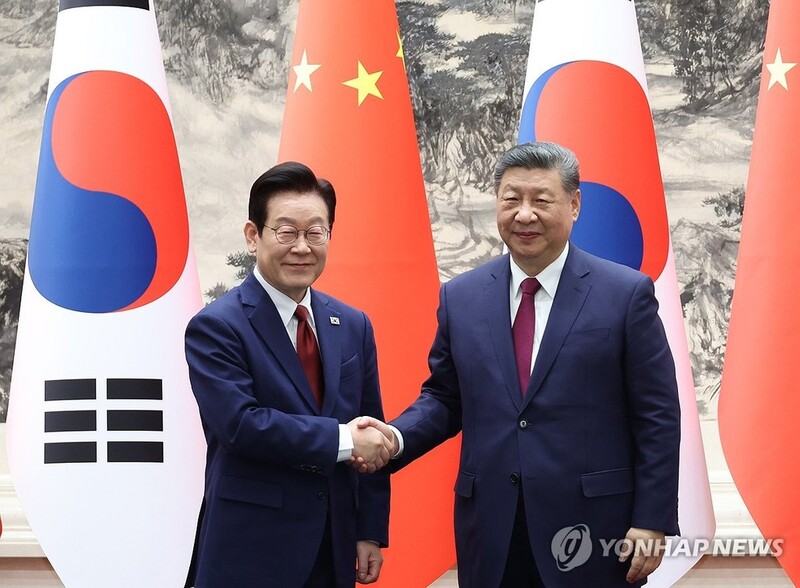 |
| ▲ President Lee Jae Myung (L) shakes hands with Chinese President Xi Jinping during a signing ceremony of memorandums of understanding at the Great Hall of the People in Beijing on Jan. 5, 2026. (Yonhap) |
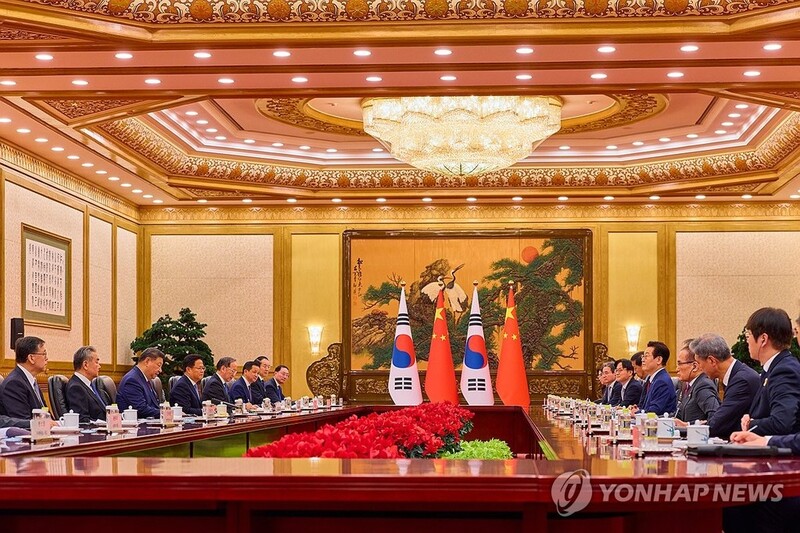 |
| ▲ President Lee Jae Myung and Chinese President Xi Jinping hold summit talks at the Great Hall of the People in Beijing on Jan. 5, 2026. (Pool photo) (Yonhap) |
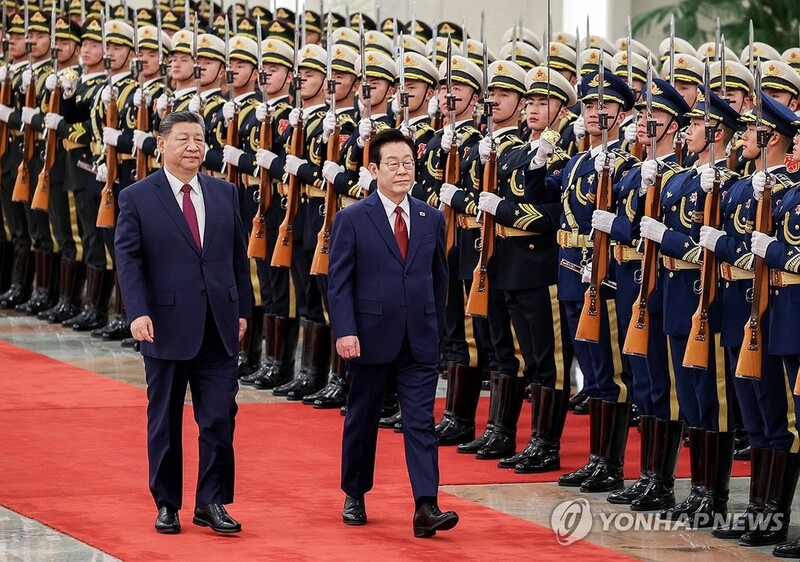 |
| ▲ President Lee Jae Myung (R) and Chinese President Xi Jinping attend an opening ceremony at the Great Hall of the People in Beijing on Jan. 5, 2026, ahead of their summit. (Yonhap) |
(ROUNDUP) Lee-China-summit
(ROUNDUP) Lee, China's Xi share view on importance of resuming talks with N. Korea
(ATTN: UPDATES throughout; CHANGES headline)
By Kim Eun-jung
BEIJING, Jan. 5 (Yonhap) -- South Korean President Lee Jae Myung and Chinese President Xi Jinping on Monday shared the view on the importance of resuming dialogue with North Korea and agreed to explore measures for peace on the Korean Peninsula, Cheong Wa Dae said.
During the 90-minute summit, Lee underscored the importance of bilateral cooperation with China to bring North Korea back to the dialogue table at a time when Pyongyang has shown little sign of engaging in diplomacy.
The two leaders "reaffirmed peace and stability on the Korean Peninsula serves the interests of both countries," and Lee was assured of China's willingness to play a "constructive" role toward the goal, National Security Adviser Wi Sung-lac told reporters.
"The two leaders underscored the importance of resuming dialogue with North Korea," Wi said, adding that Lee and Xi would continue to seek "creative measures to establish peace" on the Korean Peninsula.
They also shared consensus on holding annual meetings and to expand communication and exchanges among defense authorities to "build mutual trust and contribute to regional peace and stability," he said.
Since taking office in June 2025, Lee has extended an olive branch to North Korea in an effort to improve strained ties, but Pyongyang has remained unresponsive to his peace overtures.
Although peace efforts were high on the agenda, Lee avoided directly mentioning the goal of the denuclearization of North Korea as the summit focused on boosting cooperation in practical areas.
"(I) will work together (with China to) explore viable alternatives for peace on the Korean Peninsula so that both countries can jointly contribute to peace, the basic foundation for prosperity and growth," Lee said in his opening remarks.
The summit also discussed sensitive issues, amid Seoul's concerns over Beijing's steel structures in a jointly managed Provisional Maritime Zone (PMZ) in the Yellow Sea.
Since 2018, China has installed steel structures in and around the PMZ, raising questions over China's intentions behind their installation amid concerns over Beijing's growing territorial assertiveness in the South and East China Seas.
Both sides shared the view that turning the Yellow Sea into "a peaceful and co-prosperous sea" is important for the stable and long-term development of relations, and agreed to continue "constructive" consultations, Wi said, adding that he holds "cautious hope" for making progress on the issue.
As the maritime boundary between the two countries has not been clearly demarcated, the two sides also agreed to hold vice-ministerial talks on the issue within this year.
The two leaders also discussed cultural exchanges, as Seoul seeks to expand Korean content's access to China, which has faced unofficial restrictions since South Korea hosted a U.S. missile defense system in 2017. Beijing does not formally acknowledge such restrictions.
Lee and Xi discussed gradually expanding cultural exchanges in areas such as Go and soccer, and agreed to have working-level officials explore cooperation in dramas and films, the security adviser said.
The two leaders also noted the need to work together to address negative sentiment toward each other's countries.
Asked whether China sought clarification on Lee's position on Taiwan, Wi said the president reaffirmed Seoul's respect for the "One China" policy and stressed the need for mutual respect to ensure stable bilateral relations.
In his first visit to China, Lee voiced his expectations for the summit with Xi, saying that it will be an important opportunity to make 2026 the first year for the "full restoration" of South Korea-China relations.
His visit came at a time when South Korea is seeking to stably manage relations with China, a key partner in trade, tourism and peace efforts on the Korean Peninsula, while also maintaining a strong alliance with the United States under his "pragmatic" diplomatic approach.
Seoul-Beijing ties were strained under former President Yoon Suk Yeol's closer alignment with the U.S. amid intensifying rivalry between the world's two largest economies.
Lee noted that the two neighboring countries have maintained friendly ties for thousands of years and share a history of suffering the loss of sovereignty and fighting for independence, an apparent reference to Japan's colonial expansion in the early 20th century.
He also said his administration will continue to expand cooperation on an "equal footing" in areas that directly affect the daily lives of people in both countries and strengthen collaboration on livelihood issues.
"I will invariably make efforts to develop our strategic cooperative partnership into an irreversible trend of the times," he said, expressing his wish to work together with Xi to open a "new phase" for the development of bilateral relations.
Xi shared consensus on further developing the bilateral relations through closer communication amid the changing geopolitical landscape.
"The two countries bear important responsibilities in safeguarding regional peace and promoting global development, and share broad common interests," Xi said through a translator.
Xi also said Seoul and Beijing "should firmly stand on the right side of history and make correct strategic choices, jointly oppose protectionism, practice genuine multilateralism, and contribute to advancing a balanced and orderly multipolar world and universal, inclusive economic globalization."
He said their second meeting in just two months demonstrates how much both sides value the relationship, suggesting that they should visit each other and communicate more often as "friends."
Following the summit, the two leaders attended a signing ceremony for 14 memorandums of understanding on cooperation in trade, technology, the environment and other areas, as well as a document pledging the return to China of a pair of Qing Dynasty stone lion statues purchased by the Kansong Art and Culture Foundation in 1933.
(END)
(C) Yonhap News Agency. All Rights Reserved