 |
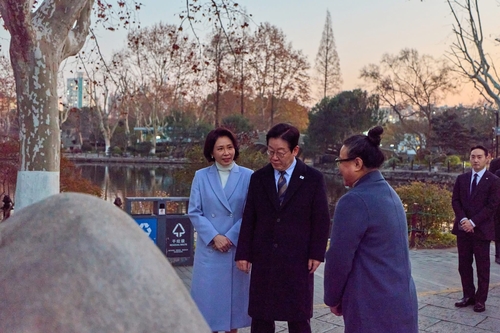
| ▲ President Lee Jae Myung (C), accompanied by first lady, Kim Hea Kyung (L), visits Luxun Park in Shanghai, in this photo captured from Lee's Facebook account on Jan. 8, 2026. (PHOTO NOT FOR SALE) (Yonhap) |
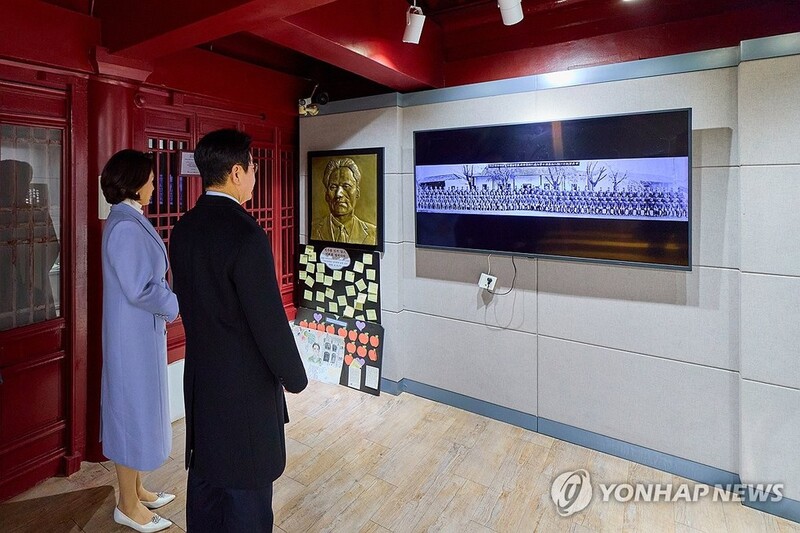 |
| ▲ President Lee Jae Myung (R) and first lady Kim Hea Kyung visit a memorial hall of Korean independence fighter Yun Bon-gil in Luxun Park in Shanghai, in this photo captured from Lee's Facebook account on Jan. 8, 2026. (PHOTO NOT FOR SALE) (Yonhap) |
Lee-independence fighter
Lee visits site of Korean independence fighter's bombing in Shanghai against Japan's colonial rule
By Kim Eun-jung
SEOUL, Jan. 8 (Yonhap) -- President Lee Jae Myung said Thursday he had visited a historical park in Shanghai where Korean independence fighter Yun Bong-gil (1908-1932) carried out a bombing to protest against Japan's colonial rule.
In a Facebook post, Lee said that he toured Lu Xun Park, formerly known as Hongkou Park, on the final day of his state visit to China, following his visit to the nearby historical site of the former headquarters of the Provisional Government of the Republic of Korea.
Yun detonated a bomb at the park during a Japanese celebration to mark the birthday of Emperor Hirohito and the occupation of large parts of Shanghai in 1932, killing or fatally wounding several senior Japanese officials.
Lee described the site as the place where Yun "made a declaration of his country's sovereignty and the dignity of his people."
"The bomb that a young man from a small and weak country threw was an outright challenge to the imperialist order of invasion and exploitation, expressing his firm belief that solidarity for peace is possible," he wrote.
He evaluated the incident "completely changed the course of modern East Asian history," saying it prompted the Chinese government to formally acknowledge Korea's provisional government in exile, established in 1919, and helped rally independence forces scattered across the region.
"Shanghai became a center of solidarity for freedom and dignity beyond borders," he said.
Lee vowed to remember the sacrifice and dedication of forebearers and to pursue diplomacy that promotes "peace and co-prosperity" amid a shifting geopolitical landscape.
"Scars of history have not yet fully healed and sources of confrontations still exist in many places in today's turbulent international order," he said. "In times like this, we need politics of respect rather than the logic of force, and diplomacy of cooperation rather than confrontation."
(END)
(C) Yonhap News Agency. All Rights Reserved