 |
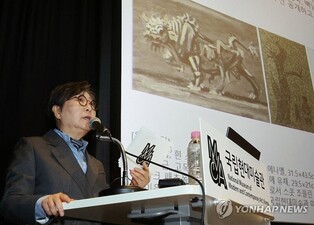
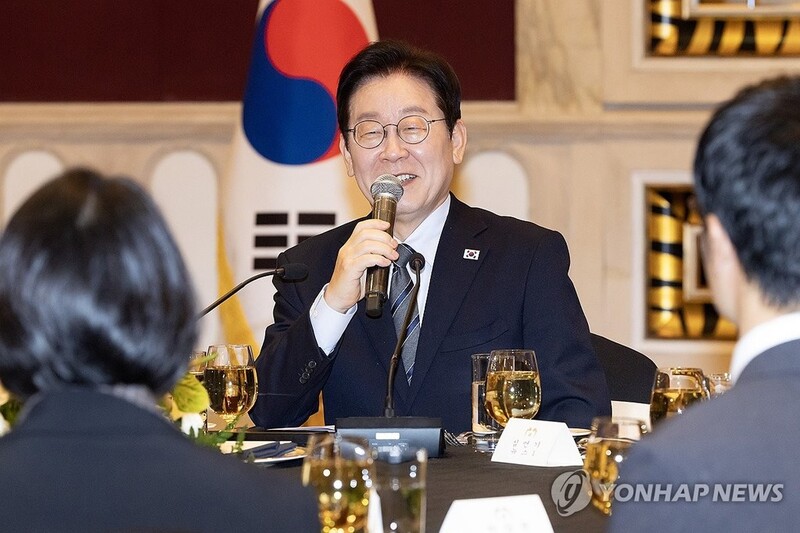
| ▲ President Lee Jae Myung speaks during a press conference at a hotel in Shanghai on Jan. 7, 2026. (Yonhap) |
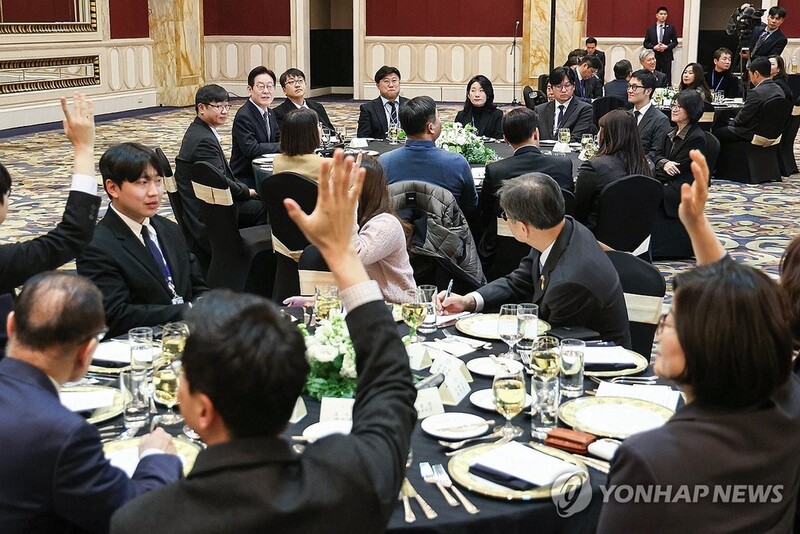 |
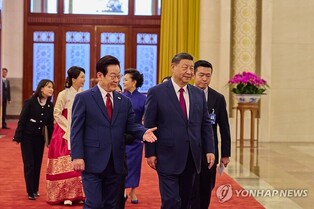
| ▲ Reporters raise their hands to ask questions to President Lee Jae Myung during a luncheon at a hotel in Shanghai on Jan. 7, 2026. (Yonhap) |
(2nd LD) Lee-press conference
(2nd LD) Lee says he asked China's Xi to play mediator role on Korean Peninsula
(ATTN: UPDATES with more quotes, details; ADDS photo)
SHANGHAI, Jan. 7 (Yonhap) -- President Lee Jae Myung said Wednesday that he asked Chinese President Xi Jinping to play the role of a mediator on the Korean Peninsula, including on the issue of North Korea's nuclear weapons.
Lee made the remark in Shanghai after holding a summit with Xi in Beijing on Monday as part of his ongoing state visit to the country.
"There's something I asked for from the Chinese side," he said during a luncheon with reporters accompanying him on the trip. "I would like (China) to play the role of a mediator on Korean Peninsula issues, including on the North Korean nuclear issue."
Lee said he explained that all channels between the two Koreas have been blocked, with "zero trust" and only hostility remaining between the sides.
"President Xi noted the efforts until now and said patience is needed," he said, expressing his agreement with the idea. "For quite a long time, we've effectively taken military offensive action against North Korea. North Korea was likely extremely nervous. In order to have dialogue with a counterpart, we have to understand the position of the other side."
Lee said that in response to his request, the Chinese side said it would work to play a mediator's role.
Beijing, Pyongyang's main ally and economic benefactor, has long been considered to have crucial leverage over the North's decision-making.
Lee's comments came as critics have raised questions about why the issue of North Korea's denuclearization was not explicitly mentioned in Cheong Wa Dae's briefing on the outcome of this week's summit.
"I think there was more progress than expected during this visit to China," Lee said, claiming the two sides shared an understanding on various issues and found ways to smoothly resolve other issues on which they could disagree.
"The government of the Republic of Korea plans to manage South Korea-China relations on the principle of mutual respect and placing one's national interest at the center so that they don't tilt to one side or get swayed by emotions," he said.
Lee fielded a wide range of questions, including on China's ban on Korean cultural content in the country and steel structures set up by Beijing in overlapping waters in the Yellow Sea.
He expressed optimism on the cultural content ban, which Beijing imposed in retaliation for Seoul's 2016 decision to host a U.S. THAAD antimissile battery on its soil. China has never formally acknowledged the existence of the restrictions.
"The Chinese government has until now said the ban doesn't exist, but this time there was something different in their expression," Lee said, quoting Xi as likening the situation to a large lump of ice that melts gradually or a fruit that falls from the tree when it ripens.
"I think that's an accurate expression," he said, adding that Xi instructed relevant government agencies to conduct detailed discussions. "It will be resolved gradually and in stages, in an orderly manner."
On the structures in the Yellow Sea, Lee sought to clarify that the two countries each have exclusive zones in the Yellow Sea and an overlapping area that they manage jointly.
The Chinese structures, he said, cross "slightly" into the overlapping waters but not into South Korea's exclusive zone.
"We decided to hold working-level talks to draw a line exactly through the middle," he said.
On tensions between China and Japan, which appeared to intensify this week with Beijing's decision to ban exports of dual-use items to the country, Lee struck a cautious tone.
"I think what we can do is very limited for now," he said, noting the export control issue is complex and deep-rooted. "When the time comes, and the situation allows for it, we will look for a role we can play."
(END)
(C) Yonhap News Agency. All Rights Reserved