dailies-editorials (2)
(EDITORIAL from Korea Times on Jan. 7)
Pro forma summit?
Seoul, Beijing must narrow differences noted during summit
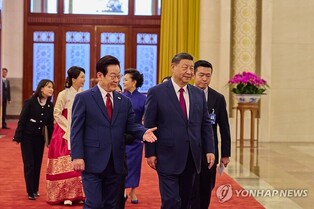
In his first state visit to China, President Lee Jae Myung conveyed to Chinese President Xi Jinping that the summit served as an important turning point for "the full restoration of Korea-China relations." He added, "I will make unwavering efforts to develop our strategic cooperative partnership into an irreversible trend of the times."
Xi responded in kind, emphasizing that "China and Korea bear significant responsibilities in maintaining regional peace and promoting global development." The Chinese president, in hosting the first state visit by a South Korean president in six years, made this pointed statement as well: "We must firmly stand on the right side of history and make the correct strategic choices."
Xi's remark spoke volumes when juxtaposed with the violently shifting geopolitical landscape. The Chinese president did not mention the United States or its recent military action against Venezuelan President Nicolas Maduro, but his call to stand on the right side of history may refer to that incident, which China has condemned as a violation of international law and a threat to peace in Latin America. The Venezuelan government has been mostly pro-China, as its oil exports largely flow there.
North Korea's recent firing of missiles was another demonstration against the U.S. actions, with Pyongyang also condemning the attack. In that vein, Seoul invariably feels pressure on its hopes of rekindling inter-Korean dialogue via China, particularly with U.S. President Donald Trump's upcoming visit to China in April. In Washington last August, Lee had asked Trump to play "peacemaker" while he serves as "pacemaker" in engaging North Korea.
Xi may have also been referring to the recent heightening of cross-strait tension between China and Taiwan as well as the sharpening China-Japan tensions, all of which Korea must counterbalance strategically and carefully in light of its alliance with the United States and forward-looking ties with Japan.
The real diplomatic challenges have arrived for Lee and his pragmatic approach to diplomacy, which is firmly underpinned by friendly trilateral cooperation with the U.S. and Japan. Seoul's relationship with China is also vital, from both the standpoint of trade as well as in dealing with North Korea.
Lee and Xi, by choosing each other for the first summit of the year, no doubt considered that friendly Seoul-Beijing talks would set the tone for defusing regional tension. But the latest instance of political instability in Venezuela has upped the challenges for both nations.
When debriefing the press after the summit, South Korea's National Security Adviser Wi Sung-lac said, "The two leaders reaffirmed joint interest in peace and stability on the Korean Peninsula." It can be noted that the Chinese side's announcement did not mention the North Korean issue. Experts are debating whether the omission is once again part of Beijing's changed stance regarding North Korean denuclearization. In its latest white paper on arms control, disarmament and nonproliferation released last November, Beijing had dropped the phrase "North Korean denuclearization." Instead, it stated, "China adopts an impartial stance and adheres to the correct approach of always working for peace, stability and prosperity on the peninsula, as well as the resolution of the Korean Peninsula issue, through political means." This stands in contrast to Lee's statement that he respects the "One China" principle in his interview with Chinese state broadcaster CCTV ahead of the summit, adding that despite the "unavoidable reality" of Seoul's security cooperation with the U.S., its relations with Beijing should not move toward confrontation.
The two leaders did manage to agree on several things: holding top-level and other meetings regularly, pledging consultations on structures deployed by China in the West Sea and the need to expand cultural exchanges. The latter refers to the so-called "Korean wave ban." While no official ban was ever issued or acknowledged, the South Korean entertainment industry faced significant barriers in China following the country's deployment of a U.S. Terminal High Altitude Area Defense system in 2016. Lee and Xi also oversaw the signing of 14 memorandums of understanding ranging from technology to environmental protection.
The two presidents, however, did not issue any joint statements. Lee will continue his four-day China visit with a stop in Shanghai, without Xi in attendance. Last month, Xi met with then-visiting French President Emmanuel Macron in Chengdu after holding official talks in Beijing earlier. The Lee-Xi summit might suffice in acknowledging differences, which will enable Seoul to calibrate its pace on sensitive issues within both bilateral and multilateral frameworks, and move toward a "new stage" in Seoul-Beijing relations. The summit may have been largely pro forma, resulting only in an agreement to meet regularly and expand cultural and creative sector exchanges in areas acceptable to both sides. However, it took the two sides six years to get here, and even the smallest takeaways must be fully acknowledged and utilized.
(END)
(C) Yonhap News Agency. All Rights Reserved