 |
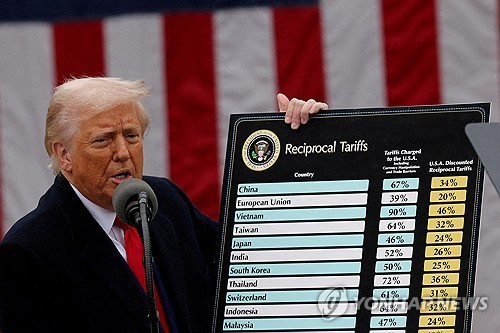
| ▲ This file photo, released by Reuters, shows U.S. President Donald Trump delivering remarks on tariffs in the Rose Garden at the White House in Washington on April 2, 2025. (Yonhap) |
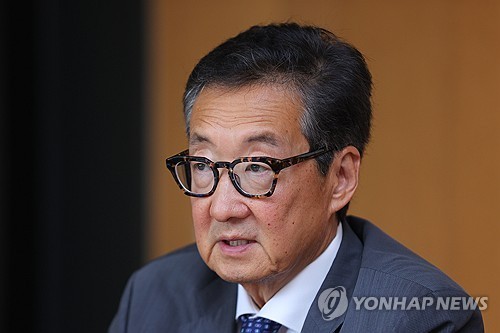 |
| ▲ This photo, taken on Sept. 19, 2025, shows Victor Cha, president of the Geopolitics and Foreign Policy Department at the Center for Strategic and International Studies (CSIS), speaking during a press meeting in Seoul. (Yonhap) |
US court ruling-tariffs
Court ruling could cut reciprocal tariffs to zero, raise questions over terms of Korea-U.S. trade deal: expert
By Song Sang-ho
WASHINGTON, Jan. 8 (Yonhap) -- A possible Supreme Court ruling against the legality of U.S. President Donald Trump's country-specific tariffs could bring the levies on South Korea down to zero from 15 percent, but would raise questions over the remaining terms of a trade deal between the two countries, an expert said Thursday.
Victor Cha, president of the geopolitics and foreign policy department and Korea chair at the Center for Strategic and International Studies, made the remarks in an analysis, amid speculation that the top court could issue a ruling concerning Trump's "reciprocal" tariffs as early as Friday.
The court has been deliberating on the legality of Trump's use of the International Emergency Economic Powers Act (IEEPA) to impose tariffs on America's trading partners. If it rules against the tariffs, his government would have to refund some US$150 billion in tariff revenues.
"A court ruling could take tariffs, now at 15 percent pursuant to the U.S.-Korea Trade and Investment Framework Agreement, down to zero percent, and would raise questions about the remaining terms of the agreement as enumerated in the Joint Fact Sheet," Cha said.
"For example, if Trump seeks to maintain tariffs through other means, this will introduce even greater uncertainty on the heels of a hard-fought agreement that provided a degree of stability in the alliance for the Lee Jae Myung government," he added.
He was referring to the bilateral trade and investment agreement, which was finalized during the second summit between President Lee Jae Myung and Trump in South Korea in late October. Its details were delineated in a Joint Fact Sheet that Seoul and Washington released in November to outline trade and security agreements.
Under the agreement, Seoul committed to investing $350 billion in the U.S., among other pledges, in return for Washington's lowering of reciprocal tariffs on Korea to 15 percent from 25 percent.
If the IEEPA case is struck down by the court, Lee could face domestic pressure to nix the trade deal with the U.S., Cha anticipated, as Seoul made a range of pledges, including the investment commitment, under Trump's reciprocal tariff pressure.
"But pulling back (from the deal) could jeopardize other valued aspects of the agreement, including shipbuilding and nuclear submarines," he said.
The joint fact sheet covers a broad range of cooperation areas, including the shipbuilding sector and Seoul's push to build nuclear-powered submarines.
Cha underscored the need for Seoul and Washington to work together to retain parts of the deal that are mutually beneficial should the court invalidate the tariffs in question.
"The two allies will have to find a way to preserve valued elements of the agreement amid domestic and partisan reactions with both administrations facing elections in 2026 (U.S. midterms and South Korean local elections) that will be seen as a popular mandate for the governments' policies," he said.
Cha noted that if the court rules against the legality of IEEPA tariffs, the Trump administration will likely seek to maintain them through alternative means, including Section 338 of the Tariff Act of 1930.
Section 338 gives the president wide authority to slap tariffs of up to 50 percent on imports from countries that are "found as fact" to be undertaking "unreasonable" trade practices discriminating against the United States.
"No previous administration has used this provision of the Tariff Act of 1930 and its application would almost certainly be challenged in court," he said.
Amid the court deliberations, Trump warned last week that losing his administration's ability to tariff countries that treat the United States unfairly would be a "terrible blow" to the U.S., describing duties as an "overwhelming benefit" to America.
Last month, Trump also said that if the top court rules against his tariff policy, it would pose the "biggest threat in history" to U.S. national security.
In April, Trump announced his plans for "reciprocal" tariffs as he used tariffs to curtail America's trade deficits, boost revenue, attract foreign investments and strengthen domestic manufacturing.
The across-the-board tariffs, which have brought a bilateral free trade agreement with South Korea in tatters, came as Trump vowed to address what he called "unfair" foreign trade practices that have "ripped off" America for too long.
(END)
(C) Yonhap News Agency. All Rights Reserved