(News Focus) Lee-China-summit
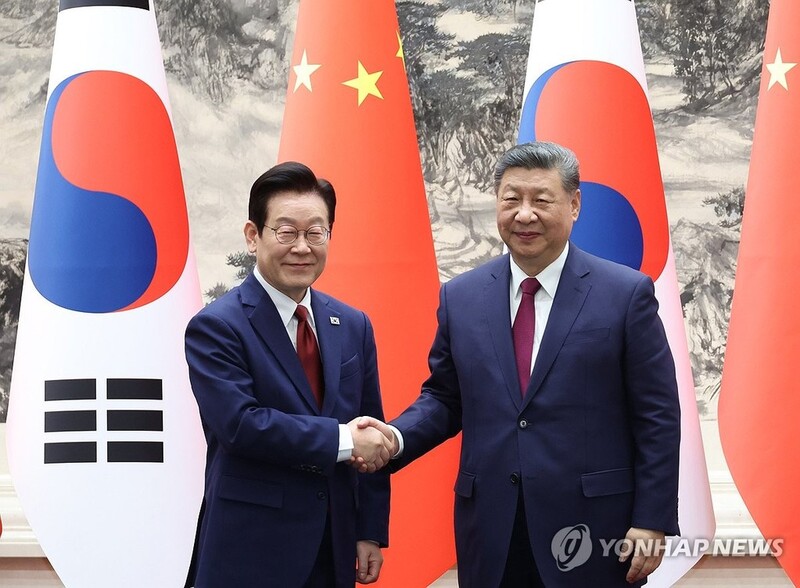 |
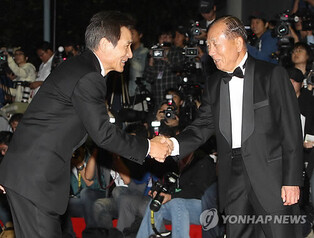
| ▲ President Lee Jae Myung (L) shakes hands with Chinese President Xi Jinping during a signing ceremony of memorandums of understanding at the Great Hall of the People in Beijing on Jan. 5, 2026. (Yonhap) |
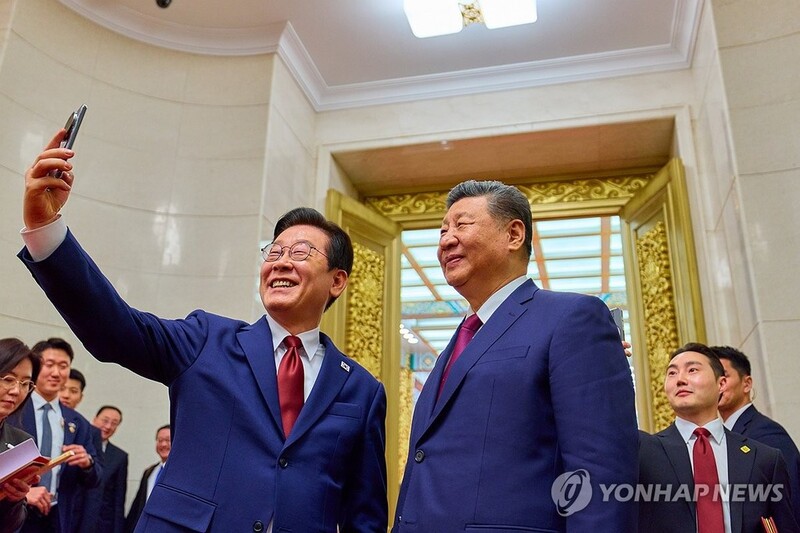 |
| ▲ President Lee Jae Myung (L) takes a selfie with Chinese President Xi Jinping after a state dinner at the Great Hall of the People in Beijing on Jan. 5, 2026. (Pool photo) (Yonhap) |
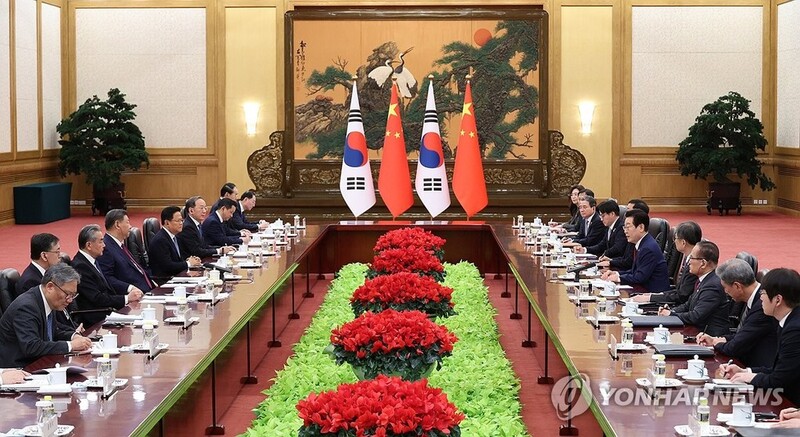 |
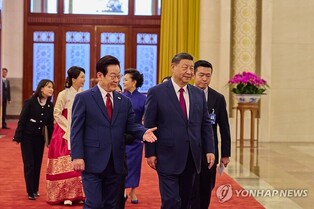
| ▲ President Lee Jae Myung and Chinese President Xi Jinping hold summit talks at the Great Hall of the People in Beijing on Jan. 5, 2026. (Pool photo) (Yonhap) |
(News Focus) Lee-China-summit
(News Focus) Lee-Xi rapport raises hope for improved ties, closer cooperation on N. Korea, maritime issue
By Kim Eun-jung
BEIJING, Jan. 6 (Yonhap) -- Apparently budding rapport between President Lee Jae Myung and Chinese President Xi Jinping is raising cautious optimism for further improvement in the two countries' relations and closer cooperation on nettlesome issues, including diplomacy with North Korea and maritime demarcation.
Lee and Xi held their second summit in Beijing on Monday, as the two countries face a raft of tasks, including fully restoring bilateral ties following a set of rough patches, tackling Pyongyang's nuclear quandary and addressing friction over China's steel structures in a jointly managed zone in the Yellow Sea, to name a few.
The leaders' friendly handshake, warm pleasantries and an exchange of gifts at the pomp-filled summit event belied lingering tension over those thorny issues and raised expectations that the Seoul-Beijing relations would be put on a more stable footing despite South Korea being a core Asian ally of China's superpower rival, the United States.
"This summit will be an important opportunity to make 2026 the first year of full-scale restoration of Korea-China relations," Lee said in his opening remarks during the 90-minute summit.
"I believe that efforts to develop the strategic cooperation and partnership between the two countries into an irreversible trend of the times will continue."
Xi said that Lee's visit is meaningful and laid the groundwork for a "new era" for Seoul-Beijing ties, calling for closer communication between the two leaders as "friends."
It marked the first visit by a South Korean president to China in seven years and the first state visit in nine years.
Relations between Seoul and Beijing deteriorated after South Korea hosted a U.S. missile defense system on its soil in 2017. The countries also went through a rough patch during former conservative President Yoon Suk Yeol's term that focused primarily on closer alignment with Washington and Tokyo.
Lee's second summit with Xi marked a culmination of his "pragmatic" diplomatic approach under which he has pledged to stably manage relations with China -- a major partner for trade, tourism and peace efforts on the Korean Peninsula -- while maintaining a robust alliance with the U.S.
Striving to rekindle long-stalled diplomacy with North Korea, Lee used the summit to underline the importance of bilateral cooperation with China to bring the recalcitrant regime back to the dialogue table, although Pyongyang has shown little interest.
Just hours before Lee arrived in Beijing on Sunday, the North fired ballistic missiles in its first weapons test of the year. The following day, Pyongyang claimed it had launched two hypersonic missiles and said its nuclear forces were ready for "actual war."
The two leaders "reaffirmed peace and stability on the Korean Peninsula serves the interests of both countries," and Lee was assured of China's willingness to play a "constructive" role toward the goal, National Security Adviser Wi Sung-lac said.
Lee's visit, accompanied by a large Korean business delegation, also raised expectations for deeper economic ties and cultural exchanges with China.
Lee and Xi oversaw the signing of 14 memorandums of agreements, including technology, trade, environment, transportation and intellectual property rights.
At a business forum attended by corporate leaders from both countries, Lee called for expanding cooperation in high-tech industries, including artificial intelligence, as well as cultural content.
During the first such event in seven years, South Korean and Chinese companies signed nine MOUs for cooperation in consumer goods, supply chains and cultural content.
The two leaders also discussed cultural exchanges, as Seoul seeks to widen access for Korean content in China after it faced unofficial restrictions following the hosting of the U.S. missile defense system. Beijing does not formally acknowledge such restrictions.
According to Cheong Wa Dae, Lee and Xi agreed to gradually expand exchanges in areas such as Go and soccer and to have working-level officials explore cooperation in television dramas and films.
Sensitive issues were also raised, including Seoul's concerns over Beijing's installation of steel structures in a jointly managed Provisional Maritime Zone (PMZ) in the Yellow Sea.
Since 2018, China has installed such structures in and around the zone, fueling worries in South Korea about its growing territorial assertiveness in the South and East China Seas.
Both sides agreed that turning the Yellow Sea into "a peaceful and co-prosperous sea" is important for stable relations and decided to continue consultations, the security adviser said.
As the maritime boundary between the two countries has not been clearly demarcated, the two sides also agreed to hold vice-ministerial talks on the issue within this year.
(END)
(C) Yonhap News Agency. All Rights Reserved