 |
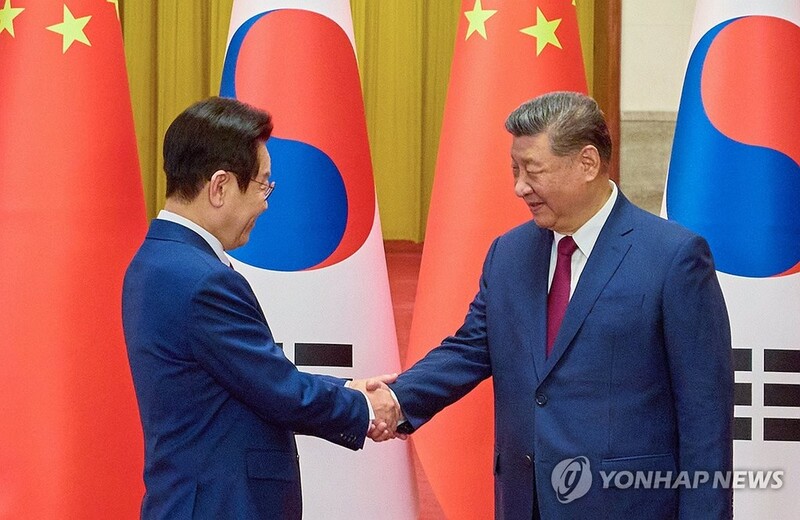
| ▲ President Lee Jae Myung (L) shakes hands with Chinese President Xi Jinping during a signing ceremony of memorandums of understanding at the Great Hall of the People in Beijing on Jan. 5, 2026. (Pool photo) (Yonhap) |
China-Yellow Sea structures
Lee, Xi concur on turning Yellow Sea into 'peaceful' sea amid concerns over steel structures
By Kim Eun-jung
BEIJING, Jan. 5 (Yonhap) -- President Lee Jae Myung and Chinese President Xi Jinping agreed Monday that turning the Yellow Sea into a "peaceful and co-prosperous" sea is important for the stable development of bilateral ties, Cheong Wa Dae said, amid Seoul's concerns over Beijing's steel structures in a jointly managed maritime zone.
During their summit in Beijing, the leaders shared the view and agreed to continue "constructive" dialogue on the structures in the Provisional Maritime Zone (PMZ), an area in the Yellow Sea where the exclusive economic zones of South Korea and China overlap, according to presidential spokesperson Kang Yu-jung.
Since 2018, China has installed steel structures in and around the PMZ, raising questions over China's intentions behind their installation amid concerns over Beijing's growing territorial assertiveness in the South and East China Seas.
"The leaders of both countries shared the understanding that turning the West Sea into a peaceful and co-prosperous sea is important for the stable and long-term development of relations, and agreed to continue constructive consultations on the structures in the West Sea," Kang said in a written statement, referring to the Yellow Sea.
Lee also called for China's improved measures to address illegal fishing in the Yellow Sea, she said.
During a policy briefing last month, Lee instructed maritime police to take firm measures against illegal fishing by Chinese vessels in South Korean waters, citing violent resistance from some Chinese fishing boats.
The two leaders also discussed cultural exchanges, as Seoul seeks to expand Korean content's access to China, which has faced unofficial restrictions since South Korea hosted a U.S. missile defense system in 2017. Beijing does not formally acknowledge such restrictions.
"The two sides agreed to expand cultural and content exchanges gradually and step by step, starting with areas acceptable to both sides, and to advance consultations on the details," the spokesperson said.
On the occasion of Lee's state visit, a pair of Qing Dynasty stone lion statues that the Kansong Art and Culture Foundation has kept in its collection since purchasing them in the 1930s will be returned to China.
The National Museum of Korea signed a certificate with China's National Cultural Heritage Administration to formalize the return, with the artifacts expected to be handed over around April or May, Kang said.
North Korea was also on the agenda amid heightened tensions following Pyongyang's tests of several ballistic missiles on Sunday, just hours before Lee arrived in Beijing.
The two leaders reaffirmed that peace and stability on the Korean Peninsula are a "shared interest" of both countries and Lee was assured of China's willingness to play a "constructive" role toward that goal, she added.
(END)
(C) Yonhap News Agency. All Rights Reserved